
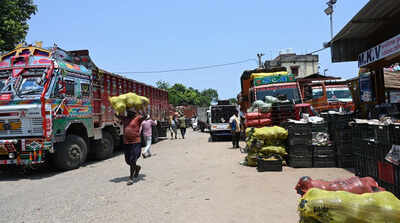
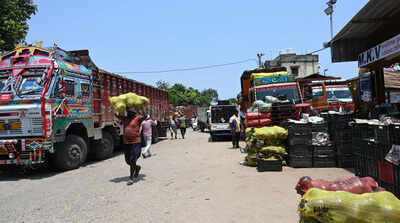
The vegetable mandi in Bhubaneswar, Unit 1
Bhubaneswar: At a time when consumers feared a spike in vegetable prices amid the ongoing fuel crisis, city retailers bought them at throwaway prices at one of the state’s largest wholesale vegetable markets at Unit-1 in Bhubaneswar on Saturday. But it didn’t trickle down to the end consumer as the retail vegetable prices remained unchanged.At the wholesale market, carrots and beetroots were sold at Rs 10 to Rs 15/kg, against Friday’s Rs 25 to 27/kg — nearly half of what they were priced. Similarly, papaya was sold at Rs 10/kg, cucumber at Rs 15/kg, way down from Rs 42/kg on Friday, and ridge gourd (Rs 35/kg a day ago), ivy gourd, lady’s finger (Rs 30/kg) and pointed gourd were sold between Rs 15 and Rs 20 per kg on the day.A disruption in fuel supply severely affected transportation of stocks on the day, forcing wholesalers to sell perishable vegetables at nearly half their usual prices, and, in turn, suffering heavy losses. Unit-1 traders said retailers and wholesalers from different parts of the state failed to arrive at the market to lift stocks as many transporters either ran out of fuel or remained stranded in long queues outside petrol pumps.Odisha’s vegetable needs are largely met from other states, including neighbouring West Bengal, Chhattisgarh and Andhra Pradesh, besides Karnataka, Maharashtra, Uttar Pradesh, Madhya Pradesh and Rajasthan. After the vegetables arrive at Unit-1 market, they are transferred to different retail markets across various districts like Cuttack, Khurda, Puri, Jagatsinghpur and Dhenkanal. However, business remained unusually dull on Saturday morning, with very few pickup vans and traders turning up.As a result, the wholesalers were left with no option but to dispose of raw vegetables at throwaway prices to avoid spoilage.Kabiraj Swain, president of Vegetable Traders’ Association, said the situation dealt a major blow to wholesalers. “On an average, 50 to 60 trucks, each carrying 25 tonnes of vegetables, reach the market from different states every morning. And at least 200 mid-sized vehicles, including pickup vans, arrive at the market every morning to transport the vegetables to different parts of the state. That did not happen today (Saturday) because transporters either had no fuel or were waiting in queues at fuel stations,” he said.Swain added that since vegetables cannot be stored for long during summer, traders had no option but to sell them at half the market price. “The wholesalers are among the worst affected,” Swain said.Traders fear losses could deepen further if the fuel situation does not normalise soon, as supply chain disruptions may continue to affect transportation and procurement.On the other hand, traders in Cuttack’s biggest vegetable market, Chhatra Bazaar, said the panic buying of fuel, which resulted in a crisis in the last three days, has not yet affected the vegetable business here. “Instead, in Cuttack’s Malgodown, we witnessed panic buying of cooking oil in the last three days but today, the prices of all varieties of cooking oil came down, which means loss for those who resorted to hoarding,” said Prafulla Chatoi, general secretary of Cuttack Chamber of Commerce.