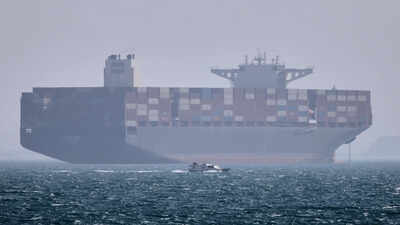
For thousands of sailors stranded on nearly 1,600 ships in the Strait of Hormuz, “Project Freedom” turned out to be more of a pit stop than passage. US President Donald Trump’s much-talked-about plan to help commercial vessels cross one of the world’s most dangerous waterways lasted just 48 hours, with only two ships making it through under US military guidance before the operation was paused, according to CNN.That has left most shipping companies and crews back in limbo, with missiles still flying over the 21-mile strait despite a ceasefire, and few willing to risk moving.
“Nothing short of a true peace accord that is demonstrated and proven will gain the confidence of the commercial shipping community,” Gene Seroka, executive director of the Port of Los Angeles told the agency.Seroka, who previously worked in the Middle East for major shipping company American President Lines, said he has not spoken to a single shipping executive willing to move cargo or crew through the strait, even with US military support. Before the conflict began, around 120 ships passed through the Strait of Hormuz every day, carrying a large share of the world’s oil. But for more than two months, many vessels have been waiting for a safe chance to leave.The danger is not just about safety as a damaged ship could cost companies millions, and many insurers are not required to cover losses during wartime under existing contracts. US Secretary Rubio said that the Trump administration contacted several shipping companies to offer support through “Project Freedom,” but only a few agreed.Danish shipping giant Maersk said one of its ships was among the two escorted by the US military. The company said the vessel had been “unable to depart” the Persian Gulf since fighting started in February.Hapag-Lloyd was also looking at using US military help to move its remaining four ships before the programme was paused. “As the situation has changed again overnight, we need to see if and how it will work,” said Nils Haupt, senior director group communications, at Hapag-Lloyd. Haupt also said another overnight attack on a container ship, which caused injuries, showed how dangerous the route still is.
Hormuz havoc continues to wreck
Since the war began, 32 ships have been hit by missiles, causing 10 deaths and at least 12 injuries, according to the International Maritime Organization (IMO). The IMO has told ships to “exercise maximum caution” and warned that “naval escorts are not a sustainable long-term solution.”A regional source familiar with talks told CNN that the United States and Iran are moving closer to a deal to end the war, but the Trump administration has warned that talks have failed suddenly before.After Trump paused “Project Freedom,” Iran said ships could still travel safely through the strait under “new procedures.” Iran also launched the Persian Gulf Strait Authority, which according to state-owned Press TV would manage ship movement and tolls in the area.The United States has said before that Iran does not have the authority to control the waterway. Seroka said shipping companies still need much stronger proof that the route is truly safe before they act. “They’re going to need a lot more confidence in the safety and security of passing through the straight before they take that step,” he said.