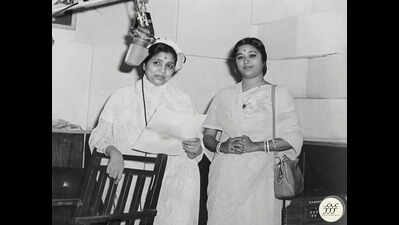
Bhubaneswar: People in Odisha joined millions of fans worldwide to mourn the death of legendary playback singer Asha Bhosle, whose versatile voice has defined Indian music for decades.During her glittering career, Asha had shared a small but significant connection with the Odia music industry. Members of the film fraternity said at a time when regional cinema and music were striving for wider recognition, her association brought both credibility and national attention to Odia compositions.Asha sang in around six Odia films, said film historian and author Surya Deo, and in one of them all the three Mangeshkar sisters — Lata, Asha and Usha — had done playback.While it is widely believed that Asha’s stint with the Odia film industry began with Ganesh Mohapatra’s ‘Samaya’, her first Odia film song was actually from the film ‘Arundhati’, which was released in 1968. She sang ‘Rasia Re’, which was composed by Santanu Mohapatra.‘Arundhati’ was the only Odia film in which Lata, Asha and Usha sang songs. This film had eight songs. “Asha’s song was included in the first edition of the lengthy film. But when the film was shortened, the song was removed from both the film and the gramophone record,” Deo said.Years later in 1975, she sang ‘Jhimi Jhimi Ta Maaja Dakile Na Chhadibu’ for ‘Samaya’, the music of which was composed by Pandit Hariprasad Chaurasia and Bhubaneswar Mishra. “It was a cabaret-style song which went on to become a huge hit,” Deo reminisced.“Whenever female playback singing in India is discussed, Asha Bhosle is the first name that comes to mind, at least for those of my generation. I was introduced to her music by my mother, Aparajita, and my maternal grandfather, and her incredible range has always amazed me. There is also a personal connection — my mother had acted in Topaye Sindura Dipata Shankha, in which Asha ji had sung Moina Moina, a song that went on to become a big hit,” recollected actor Babushaan.In 1981, Asha sang ‘Jahna Go Tume Jhurana’ from the film ‘Arati’. She went on to record another song, ‘Mu Hajichi’, from the film, ‘Sandhya Tara’, but the film was never released.In 1992, she lent her voice for the song ‘To Na re Pindhili Sadhi’ from the film ‘Maa’, the music of which was composed by her husband R D Burman. This was her last Odia film song.“Film-makers of my generation grew up listening to her songs. They were an inseparable part of our lives. While Lata Mangeshkar had her own timeless charm, the sheer range and versatility that Asha Bhosle brought to playback singing was truly unmatched,” said Sabysachi Mohapatra, a National Award winning film-maker, who had met Asha once in Mumbai during a recording session.Asha, who was awarded the Akshay Samman in 2011, had also lent her voice to a Sambalpuri song, ‘Uansa Andhare Nai Desi Sina’, for the film ‘Chinni’.Her contributions were not limited to film music alone. Asha also recorded devotional and modern tracks, which gained popularity among listeners across generations. Her last devotional Odia song was a Jagannath bhajan, ‘Manimaa’, in 2017. “We had initially approached Lata Mangeshkar for the bhajan, but it did not work out and subsequently, Asha Tai stepped in because it was a Jagannath bhajan,” remembered Bapu Goswami, who had written the lyrics for the bhajan.In 2020, during Covid, Asha along with her granddaughter Zanai and Shankar Mahadevan, sang the state anthem ‘Bande Utkala Janani’ and dedicated it to the frontline workers of Odisha. “The beautiful song composed by Shankar, Ehsaan, Loy is our small tribute to the people of Orissa and the frontline workers over there fighting the virus. Though the song is in the Odiya (sic) language, I’m sure you will appreciate the emotions behind it and give your full support to these brave people of Orissa. Jai Hind,” Asha had posted on social media.