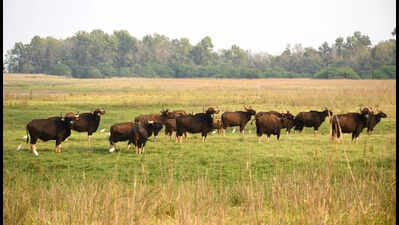
Bhubaneswar: More than 600 participants from diverse sections of society took part in the second bison festival at Debrigarh Wildlife Sanctuary on Sunday.This year’s festival introduced night-camping as a special feature, offering participants a unique opportunity to experience wilderness.The participants included eco-development committee members from villages adjoining the sanctuary, students, officials and wildlife enthusiasts from Sambalpur, Bargarh, Jharsuguda, Sonepur, Balangir, and other districts. Noted bison expert Dr K Shankar and IG (northern range) Himanshu Lal addressed the participants in the presence of Anshu Pragyan Das, divisional forest officer, Hirakud wildlife division.DFO Das said a key addition this year was night-camping, designed to give visitors a closer experience of Debrigarh’s wilderness. “The morning session featured expert deliberations on the Indian bison, a wildlife documentary screening and prize distribution for a drawing competition held for school and college students. The junior theme was ‘Strength of the Wild – Pride of Debrigarh Sanctuary’, while senior participants competed under ‘Wild Heritage of India – The Mighty Gaur’.”The programme also recognised frontline conservation work, with awards presented to the best-performing foresters and forest guards for their contribution to gaur protection and conservation. Following the formal session, participants joined a 2.5-hour gaur safari inside the sanctuary. “Night-camping visitors will also take part in star-gazing, viewing constellations from Saptarishi Mandal to Orion under the clear night sky over the sanctuary and the nearby Hirakud wetland,” Das added.Debrigarh emerged as a major conservation landscape for the Indian bison in eastern India. Recent field observations estimated the population at around 848 individuals, an increase of nearly 190 in the past year.Wildlife officials said of four mega herbivores in India, the Indian bison was one. In Odisha, two mega herbivores were available in the wild— bison and elephant.Officials said Debrigarh was capable of supporting a larger population of bison. Maintaining the male/female ratio, focused habitat management, monitoring ecological indicators and protection remained crucial for healthy wildlife management.