
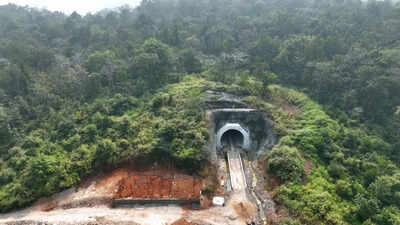
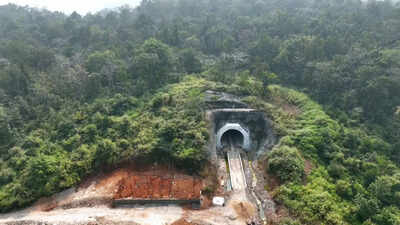
Khurda Road-Balangir new railway line – a 301km-long project conceived even before India became independent, is finally nearing full completion by early next year. One of the country’s oldest pending railway projects, it passes through five districts — connecting Khurda, Nayagarh, Boudh, Sonepur and Balangir — with three districts already getting railway connectivity.Considered an engineering marvel that ‘serves as a fine example of prioritising environmental safeguards’, a major portion of the new line — a 75km stretch between Daspalla in Nayagarh district and Purunakatak in Boudh district — passes alongside Baisipalli Wildlife Sanctuary (an integral part of Satkosia Tiger Reserve) and a proposed Brutang irrigation project in Nayagarh.To minimise habitat fragmentation and reduce man–animal conflict in the forests, the railways has constructed seven tunnels covering 12.76km and several wildlife underpasses and overpasses.The project’s most important engineering structure, as per the railways, is a viaduct stretching for 4.77km, with its piers reaching heights of 26m. Once commissioned, it will be the second-longest viaduct of the Indian Railways after the Bogibeel bridge in Assam. The viaduct will work as a wildlife underpass, allowing elephants to pass easily without any obstacle (Odisha, on an average, reports 85 elephant deaths annually).Apart from elephant underpasses and overpasses, the new line project, constructed at Rs 5,000 crore roughly, has dedicated wildlife corridors and systems designed in consultation with the forest department to ensure unhindered movement of elephants and other wild animals. Once the construction is over, many places on the roofs of tunnels will be made into grazing grounds.According to the East Coast Railway (ECoR), the project’s area is a vital corridor for Odisha’s elephant population. “Strategically placed underpasses and elevated viaducts allow animals to move freely without risking track collisions,” a railway officer said.Between Mahipur station in Nayagarh district and Jhatarabha station in Subarnapur district, there are 12 elephant/wildlife underpasses and six overpasses and most of them come under Daspalla and Purunakatak.“Elephants are landscape animals; they are essential ecosystem engineers and keystone species that physically shape their environment, maintaining ecological balance over vast areas. They transform forests into grasslands, create water sources and disperse seeds, which directly supports the survival of countless other species and maintains biodiversity.The construction of viaducts and elephant passes ensures that the forest reserves are not destroyed and the sensitive ecological balance that evolved over millions of years is not destroyed by human activities,” official sources said.To minimise environmental footprint, ECoR adopted ‘eco-friendly construction’ practices. “The use of high-rise viaducts instead of massive embankments saved approximately two lakh trees from being cut down. Because of the viaducts, we saved a huge amount of soil that was used for earthwork of the rail line between Buguda and Banigochha stations,” the railway officer added. At present, train services on the 226km stretch of the new line is currently operational, from Khurda Road to Daspalla and from Balangir to Purunakatak via Sonepur, covering 20 stations. With four trains running between Khurda Road and Daspalla and three between Balangir and Purunakatak, around 5,000 passengers travel on the entire stretch daily, on an average.The project has helped three districts – Nayagarh, Sonepur and Boudh – get rail connectivity. In 2017, Nayagarh got connected by trains for the first time since India became independent, Sonepur in 2024 and Boudh got connected last year.“The Khurda-Balangir railway line stands as an engineering marvel that balances technological excellence with ecological responsibility. Executed through challenging forested and hilly terrain, the project incorporates tunnels, major bridges in sensitive stretches, dedicated elephant passages and scientifically designed viaducts to protect wildlife corridors, natural flow of water bodies and ecosystems. It reflects our commitment to delivering transformative connectivity, while upholding the highest environmental safeguards under Indian Railways,” ECoR’s general manager Parmeshwar Funkwal said.